Sunday, December 5, 2010

Grounded Theory Summary


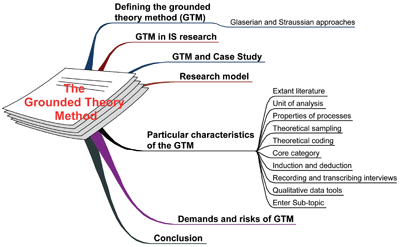
Image retrieved from Google images on December 5, 2010

I have been reading about the Grounded Theory and I have discovered that this type of analysis requires three main elements:
  • Asking questions
  • Making comparisons
  • Defining concepts
I have also found that the Grounded Theory has three levels of concepts:

  • Description: Its purpose is to contextualize, persuade and to concince that phenomenons happen within the different variables.
  • Conceptual ordering: It organizes data into categories according to the properties and dimensions, types and stages.
  • Theorizing: It compares and contrasts the different categories of data in order to draw a valid conclusion  when explaining the phenomenon. Corbin and Strauss state that there should be only one salient category and taken together with other concepts it explains the what, how, when, where and why of the phenomenon.
The following are other important concepts I consider important in order to understand the Grounded Theory:

  • Concepts are designations or labels which are attached to individual events or indicators. The researcher must look for indicators of provisional concepts of data.
  • The central ideas or sensitizing concepts are transformed into provisional research questions.
  • The brainstorming of categories and literature is made, that is, compared and fit in with the research question(s). These are a summary of of collective and abstract concepts which may become releveant for the most varied fields of investigation and types of problems. Only a few indicators will be appropriate and relevant.
  • During the process, different indicators are investigated and compared with one another and similarities and differences are considered. On the basis of this analysis of indicators, concepts are finally  specified. Here the theoretical concepts are dimensionalized or determined.
  • Changing indicators that generate new properties of a code will proceed only so far before the analysts discover saturation of ideas through the interchangeability of indicators. This means, the more numerous the indicators that are of equal significance for a concept, the higher the degree of saturation of properties of that concept for the emerging theory.
  • Concepts are developed, categorized and dimensionalized . They are enriched with indicators  like textual examples or exerpts.
  • By means of permanent comparison of the concepts using the associated text units they are categorized, related to each other, ordered, put into hierarchy and dimensionalized. Through this process, the data is broken down into dimensions, while variables are established at different levels.
  • During the coding process, the investigator is permanently switching between inductive and deductive thinking, setting up and testing concepts to create hypotheses.

Monday, November 15, 2010

Coding Procedure and Update

I have been detecting and categorizing  the most salient features of my students' speech in terms of accuracy, peer/self correction strategies and the new findings that may become future further research. So far, I have noticed improvement in most of the learners mainly because they have raised awareness on their most concurrent errors and they are starting to refrain them or they are still in the process of correcting them.

The procedure that I am following is to highlight each one of my students' speaking performances according to the five main categories (hits, misses, self-correction, peer-correction and other types of errors to be analyzed in further research). This is what I have been doing so far.

Wednesday, October 20, 2010

Approaches chosen for my data analysis stage

Image retrieved fro Google images on October 20, 2010


The approaches I have chosen to conduct the data analysis from all my data analysis intruments are based on Corbin and Strauss' (1999) Grounded Theory and Sagor's (2004) Trend's Analysis. Corbin and Strauss stated that grounded theory is "theory that is developed inductively from a corpus of data". This means I will take the data that I have collected during the implementation stage and then I am going to use known facts (from literature) to produce some general principles. To "ground" my theory I must go through a series of steps in order to filter my data so I can find the core categories and relate these among each other with the aim of creating a single story around my findings.

After creating my categories, I will find the trends or patterns from each category that led my students to improve or stagnate speaking accuracy throughout the entire three-month course. Therefore, I have to employ Sagor's "trend analysis". From this analysis, I must answer three vital questions that will eventually answer my research question. The three questions are:

  1. What did I do?: In this stage I have to describe the actions I did during the implementation process so I can detect the patterns and create a timeline.
  2. What changes occurred regarding the achievement targets?: In this stage I will identify the trends by using descriptive statistics (mode). The idea is to identify the frequency in improvement or stagnation.
  3. What was the relationship between actions taken and any changes in performance on the targets?: In this stage is where I do my interpretations of the events by linking my findings (facts) from all my data collection instruments with my knowledge (intuition).  

Tuesday, October 19, 2010

Prelude to Analysis


Image retrieved from Google images on October 20, 2010

Now that I have all my data collected (finally!) I am going to start identifying the properties and dimensions from each one of my data collection tools in order to create my categories. According to Corbin ans Strauss (1999) properties are "characteristics or components of an object, event or action The characteristics give specificity to and define an object, event or action". Dimensions are the "variations of a property along a range".

To start finding the categories, I will start by open coding my transcripts and I will use the following conventions in order to identify progress and stagnation trends. In terms of students producing accurate full-length uttereances I will use the green highlighter, if students used incorrect accuracy and they did not do any correction I will use the red highlighter. Students who self- correct will use the yellow highlighter, the ones who peer-correct or assist partners to correct accuracy will use the orange highligter and finally, all those errors that indicate salient features that are not being researched as for this project but are likely to become further future research topics are going to be highlighted in pink. 

Monday, October 18, 2010

Trascription process


Image retrieved from Google images on October, 19, 2010

I finished trascribing last Monday and it took forever (four months). It was an arduos process in which I tried to be as accurate as possible to what students actually said. It is a pity that I did some transcriptions of students who either dropped out or entered the course and did not make the final analysis group since I consider that I wasted some precious time there especially during the vacation time. I also should have started transcribing at the very beginning of vacation time in order to start coding when we started the semester. I wish I would had know at the end of last semester what Burns (2010) stated about starting categorizing as soon as you collect the data and I did not suspect that transcribing took so long. I have that ugly feeling that tells me I will have to take another semester in order to finish my project.

Wednesday, September 8, 2010

Latest Decisions Made with my Teacher and Project Director

During the last tutorial I had with Valeriya we agreed along with my teacher Liubava to only take into account those students who took the three courses. That means I need to analyze the following students' conversations: Johana, Fabiola, Andres, Diana Salamanca and Claudia. Even though Juan Pablo was with me during the entire course, he did not make this group because he only did four recordings out of the eight ones (including pre and post test recordings. During the interventions he was either absent for various reasons (business trips basically or during the first intervention his microphone did not work). I also took into consideration the students who recorded at least six times including the two tests. The rest of them did not make the analysis group because they either dropped out before (Leina, Marcela, Adriana, Maritza, Michael and Javier) or the ones who came into the course later (Victoria, Gabriel, Mayi, Diana Rodriguez and Alejandra).

Wednesday, September 1, 2010

Analytical tools for my project

Image retrived from Google images on October, 2010

LIST OF ANALYTICAL TOOLS USED FOR MY ACTION RESEARCH PROJECT


The following are the tentative analytical tools I can use during my data analysis stage:

QUESTIONING

• Helps me probe

• Helps me develop provisional answers

• Helps me think outside the box

• Helps me become acquainted with the data

• Helps me observe frequency and patterns

• Helps me to synthesize, theorize, guide and provide direction


COMPARISONS

 • Helps me notice the obvious

• Helps me find relationships and differences

• Helps me categorize and to differentiate categories

• Helps me define incidents when they are not easy to detect

• Helps me clarify concepts and increase understanding

• Helps me theorize

• Helps me bring out properties and dimensions

• Helps me examine incidents one by one


WAVING THE RED FLAG

 • Helps me go beyond biases, assumptions and/or beliefs that affect the analysis

• Helps me wonder why things happen

• Helps me define just how often an incident occurs

• Helps me avoid becoming accepting with a partial truth


LOOKING AT LANGUAGE

 • Helps me see grammatical patterns especially in the accuracy of the simple past and past continuous tenses.

• Helps me realize why learners are committing the same errors over again during the implementation stage.


LOOKING FOR WORDS THAT INDICATE TIME

 • Helps me find out if they are becoming aware of the past time expressions in order to use the verbs in simple or continuous aspects in the past tense.


TIMELINES

 • Helps me detect the performance level of each student who participated throughout the entire process.


References

- Burns, A. (2010). Doing action research in English language teaching. New York: Routledge. pp. 107-140.

- Corbin, J. &Strauss, A. (2008). Basics of qualitative research: Grounded theory procedures and techniques. Sage Publications, Inc, 3rd edition. pp.45-64.